
June 2026 community update
WARNING: this newsletter contains the name and image of an Aboriginal person who has passed away.
Board updates
VISIT FROM NSW TREATY COMMISSIONERS
The ALS Board held their regular quarterly meeting in March, where they received a presentation from NSW Treaty Commissioners Aden Ridgeway and Naomi Moran. The Treaty Commissioners are engaging with the ALS as part of their community consultations on the NSW treaty process.
These state-wide consultations are to determine whether Aboriginal people in NSW want to pursue a treaty or other formal agreement-making process.
The Treaty Commissioners will aim to give all Aboriginal people in NSW an opportunity to participate in the consultation process.
Find out more about the treaty consultations and how you can share your voice: https://www.treatynsw.info/


UPDATE ON THE ALS CONSTITUTION RENEWAL PROCESS
As we reported in our last newsletter, the Board has been working with members and management to refresh the ALS Constitution. This has been a lengthy and complex process.
The Constitution was first adopted in 2006 and the ALS has grown significantly since then. An independent governance review found that parts of this important document are outdated and need to be refreshed to remain fit for purpose.
We took a new draft Constitution to our AGM late last year, where our members raised some further revisions. The Board and executive team are now working to implement these revisions. This remains an ongoing and high-priority project for the organisation.
HONOURING WIRADJURI ACTIVIST AND MATRIARCH AUNTY ANN WELDON
With sadness and great respect, the ALS marked the passing of Wiradjuri warrior Aunty Ann Weldon AM on 5 April 2026.
Aunty Ann was a founding member of the ALS and has served as our CEO, Company Secretary, and as a Board Director.
In addition to her foundational role within the ALS, she was closely involved in the establishment of other Aboriginal Community-Controlled Organisations in Redfern including the Aboriginal Medical Service and Aboriginal Children’s Service, as well as the NSW Aboriginal Land Council.
Aunty Ann was awarded a Member of the Order of Australia in 2025 for significant service to the Indigenous community of NSW, and received the Dreamtime Elder of the Year award in 2020.
“Ann Weldon was a mighty woman—one of the strongest Aboriginal women I have ever met,” said Keith Morgan, ALS Chairperson.
“She stood up for our people in every space she walked into, always grounded in culture, community, and truth.
“Whether it was supporting the Aboriginal Legal Service, our medical services, or other community organisations, Ann gave her time, her voice, and her strength without hesitation. She will be deeply missed, but her spirit and impact will never leave us.”
Some ALS Directors attended Aunty Ann’s funeral in Cowra to honour her legacy and contributions to the ALS.

Photos of Ann Weldon courtesy of NITV.

Early ALS team members including Ann Weldon (second from right) stand in front of the office in Redfern in 1974. Photo: National Archives of Australia.
Supporting our people
Visits to women's prisons
The ALS and Legal Aid have started a new program to provide face-to-face legal support for women in two prisons.
A specialist ALS lawyer and Aboriginal social worker visit Silverwater Women's Correctional Centre and Dillwynia Correctional Centre every week, offering culturally safe legal advice and assistance for Aboriginal and Torres Strait Islander women. Legal Aid lawyers also make visits for non-Indigenous women.
We can provide legal help with a wide range of issues including making formal complaints about treatment in custody; reporting officer misconduct; accessing victims’ compensation and redress schemes; resolving unpaid fines; maintaining housing while in custody or keeping housing applications active; liaising with Justice Health to get access to medication and treatment; and more.
Our social worker can provide emotional and cultural support, information about how to navigate the system, referrals to other specialist services, and pre-release support for a smooth transition back into the community.
Women in Silverwater Women's Correctional Centre and Dillwynia Correctional Centre can book an appointment with our team by requesting a referral form from the Services and Programs Officer (SAPO). They can also call the ALS on the CADL (#12) and request to speak to the Women’s Advocacy Service.
If you’re worried about a loved one in custody, you can call us on 1800 765 767 and press 3 for civil law assistance to talk with a member of our team.
Thank you for your survey feedback
We surveyed 791 clients late last year and were really pleased with the results.
97% of respondents said they would recommend the ALS to other people and agreed that we listened to their legal problem. 96% of respondents said we helped them understand how to deal with their legal problem, and they know where to get help if they have another legal problem in the future.
We received some great feedback like “my voice was heard when other people palmed me off”; “it’s nice to have someone to fight for me”; and “I knew [the ALS] would be able to point me in the right direction”.
We also acknowledge there are some areas for us to work on – like ensuring our high volume of phone calls and messages are answered, and keeping clients updated on their case.
Thank you to everyone who took part in the survey and helped us understand what we’re doing well and what we could do better.
Last year at a glance

Last financial year we provided 148,247 services – the highest number on record.
Here’s some of the ways we supported community:
- We expanded our justice reinvestment work to Kempsey and Nowra
- We increased the number of people helped with criminal law problems
- We supported community members to write-off $1.5 million in fines
- We made 925 visits to 335 children and young people in NSW youth prisons
- We supported 121 family members whose loved ones died in custody
- We helped prevent homelessness in 241 cases
- We used a temporary, one-off grant from the NSW Government to expand our specialist children’s legal representation to Moree, plus outreach in Armidale and Tamworth (currently funded to late 2026)
- We more than doubled the number of children’s care and protection and family law services provided since last year
If you need legal help, give us a call on 1800 765 767.
Things to know
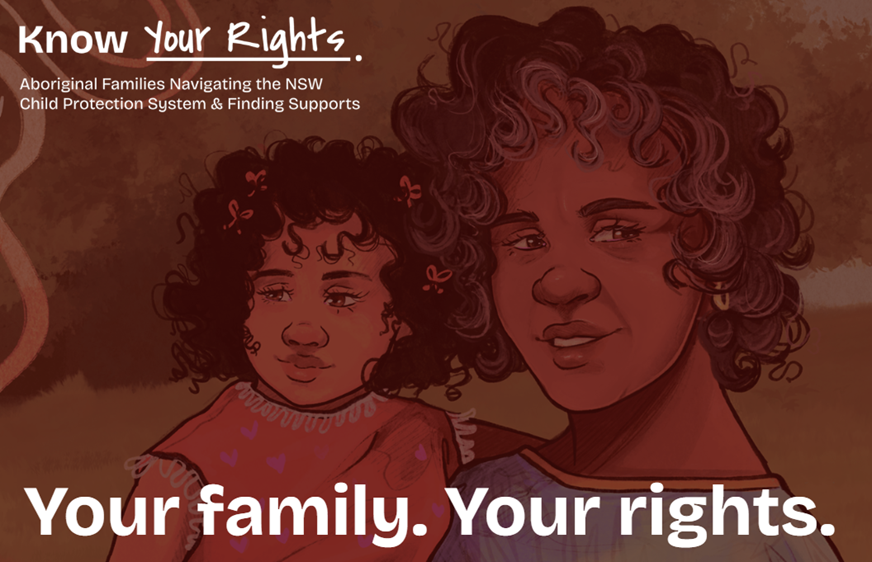
Know Your Rights is now live at www.kyr.org.au.
It’s a new resource built by and for Aboriginal and Torres Strait Islander families dealing with the NSW child protection system (also known as the Department of Communities and Justice or DCJ).
The website includes:
- Step-by-step explanations of the system
- Information guides
- Videos and animations
- Lived experience stories
- Tools to help you document your own evidence and know your options.
It provides clear, practical information – so you can be informed, confident and supported.
The team at AbSec NSW led the Know Your Rights project, and we were proud to be one of several organisations who were also involved. But most importantly, we acknowledge and pay deep respect to the Aboriginal participants in the "Bring Them Home, Keep Them Home" research project whose voices led and are heard throughout these resources. This research project is led by proud Wiradjuri woman and mother, Associate Professor BJ Newton.
Important information for anyone with a hidden safety phone
Tests are coming up soon for a national emergency alert system. If you are keeping a secret phone for your safety, it’s important to be prepared.
The emergency alert test will send notifications to your mobile phone. It will make your phone vibrate and play a loud sound for about 10 seconds. This will happen even if your phone is on silent mode.
If you don’t want your phone to make a noise, you can:
- Turn it off
- Turn on airplane mode
- Give it to a trusted friend or family member
- Store it somewhere safe and far away from your abuser – like a locker at work
The test will happen at:
- Duffy, ACT: 10:30am on Wednesday 10 June
- Liverpool, NSW: 4:00pm on Wednesday 17 June
- Queanbeyan, NSW/ACT border: 2:00pm on Sunday 21 June
- Everywhere across Australia: 2:00pm AEST, Monday 27 July
There are tests scheduled in other states and territories too. The full list can be found at: https://www.ausalert.gov.au/alerts-explained/community-testing
If you’d like help to understand your options and plan ahead, 1800RESPECT is available. Call 1800 737 732, text 0458 737 732, or visit 1800respect.org.au to chat with a counsellor online or join a video call.
Advocating for justice
Directing children out of the system and back into community
The ALS has worked with other Aboriginal Community-Controlled Organisations (ACCOs), non-government organisations (NGOs), young people and government partners to develop a new and better approach to justice – one that directs children away from police stations, courts and youth prisons, and back into their communities, families and culture.
This new approach is detailed in our report, Therapeutic Pathways for Children. We developed the report in partnership with DCJ. This is one of the first NSW Closing the Gap projects where ACCOs and systems-impacted Aboriginal young people have had a seat at the table in designing justice policies that affect our people.
Our plan is about ensuring children can access trauma-informed and culturally safe pathways that meet their needs so they are less likely to come into contact with the criminal justice system. Our justice system was built to punish, but these children need care and support.
Our plan for establishing therapeutic pathways in NSW includes four priority areas. These are:
- Ensuring children and young people are involved in making decisions that impact them.
- Strengthening options to divert children away from the justice system and towards support in the community.
- Prioritising a service system that supports children’s wellbeing, instead of a criminal justice system response.
- Ensuring the government works with ACCOs in genuine partnership, providing them with meaningful funding to implement solutions.
The report makes several recommendations to the NSW Government to put these priorities into action, and two of those solutions have been funded by the government so far. Find out more, including what’s next, at www.alsnswact.org.au/therapeutic_pathways_for_children.
Thank you to the expert research team at the University of NSW, led by Kalkutungu and South Sea Islander researcher, Peta MacGillivray; youth ambassadors from Mounty Aboriginal Youth and Community Services; representatives from several ACCOs and NGOs; and senior government representatives from DCJ and a number of other agencies for their important contributions to this project.
Calling for national action on youth justice
Our national peak body, National Aboriginal and Torres Strait Islander Legal Services (NATSILS), is campaigning for the Prime Minister to show leadership and take action on youth justice.
NATSILS has launched an open letter signed by more than 200 organisations and leaders, calling for a national emergency summit. This would be an event where key decision-makers in government can listen to the voices of Aboriginal and Torres Strait Islander legal experts and leaders in a setting where community-controlled organisations lead the discussion.
There is also a petition that anyone can sign. So far, there are over 1,200 signatures. Can you help us reach 1,500?
Connecting with community
Shaping a Local Justice Plan in Kempsey
Alongside our local justice reinvestment partner, Learning the Macleay, we recently held forums with ACCOs, local government agencies and NGOs in Kempsey.
These forums were held to share information on the Aboriginal Justice Partnership project, and to establish a Local Justice Partnership – a community-driven strategy that outlines how local justice-related issues will be addressed between the Aboriginal community and justice sector agencies.
Local Justice Partnerships and Plans can help to connect the great work already being done by our communities on statewide, shared decision-making under Closing the Gap. They are also a tool for system reform; ensuring the expertise of Aboriginal people, communities, and ACCOs have equal power in the design and development of policies and frameworks that impact them.

Close the Gap Day at Silverwater Women's Correctional Centre
Staff from our Women’s Bail Advocacy Program and Women’s Advocacy Service represented the ALS at this workshop, connecting with other organisations working towards the shared goal of improving outcomes for people in custody.


